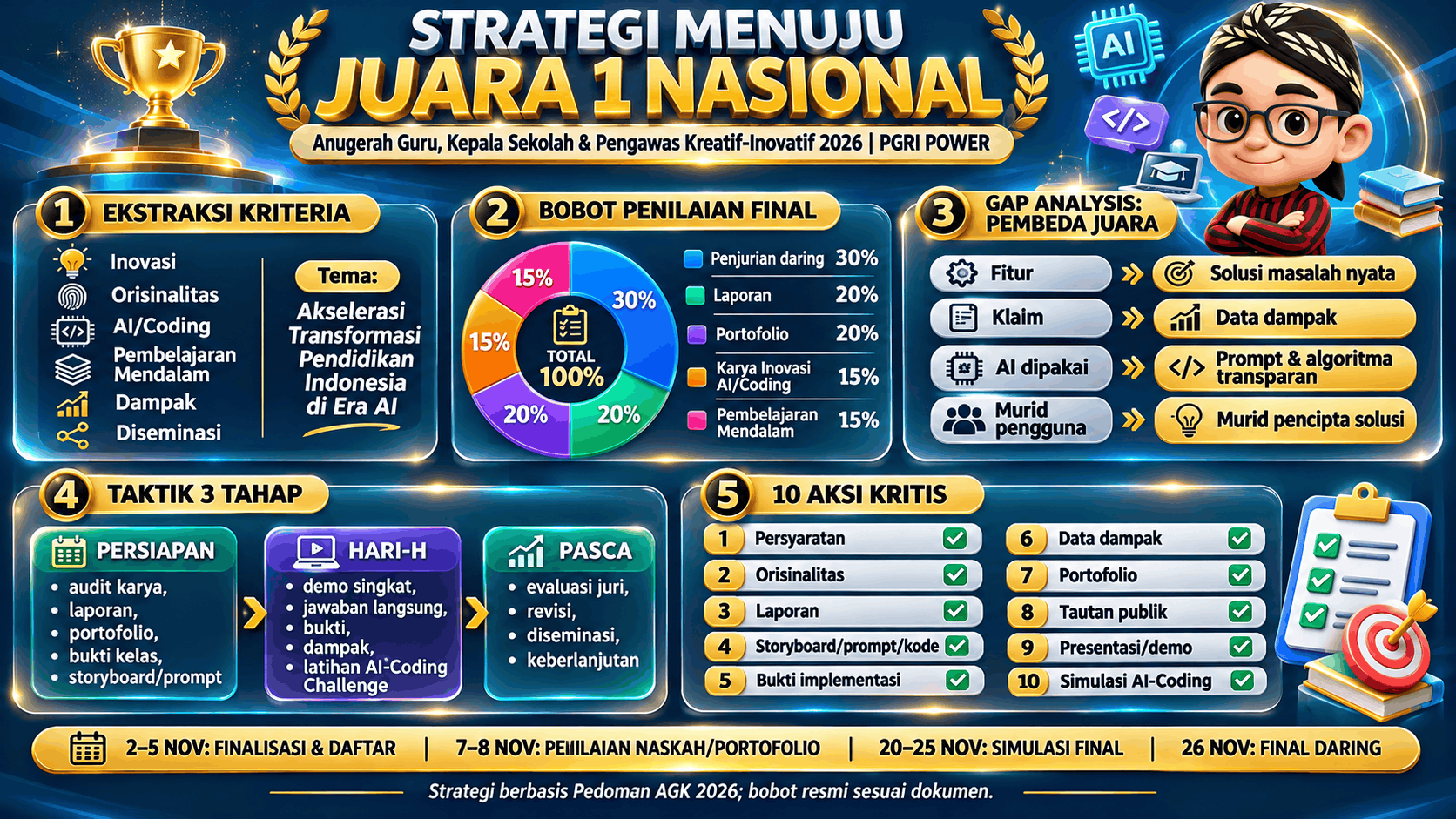
A Strategy for Building
Educational Innovations that Are Impactful, Measurable, and Sustainable
Attachment Link:
https://canva.link/qqhsh3hzehb0ll6
Introduction
The Creative & Innovative
Teachers, Principals, and School Supervisors Award (AGK) recognizes educators
and educational leaders who develop meaningful innovations in education.
Preparing for AGK 2026 requires more than creating an outstanding innovation.
Participants must also be able to explain, demonstrate, and defend their work
with credible evidence.
An analysis of the AGK 2025
interview transcript provides valuable insights. The interview is not merely a
presentation session; it is an assessment of the innovation’s substance,
implementation, leadership, collaboration, educational impact, and technical
and pedagogical mastery.
1. Understanding the Interview
Assessment Patterns
Based on the analyzed AGK 2025
interview patterns, several areas may become important considerations for the
jury:
Participants should therefore
prepare concrete, logical, and evidence-based responses rather than relying
solely on conceptual explanations.
2. Preparation Strategies
Before the Interview
Interview preparation should be
systematic and structured.
First, develop an innovation
narrative. Participants should be able to explain the problem, novelty,
objectives, implementation, and impact of their innovation concisely, including
through a 60-second presentation.
Second, prepare implementation
evidence. Activity documentation, learning outcomes, evaluation data,
testimonials, and records of actual use can strengthen the presentation.
Third, master the innovation’s
substance. Participants should understand its design, workflow, methods,
technologies, and the rationale behind their chosen approach.
Fourth, conduct interview
simulations. Practicing both primary questions and follow-up questions can
improve clarity, confidence, and response structure.
3. Strategies During the
Interview
During the interview,
participants should prioritize clear, structured, and transparent
communication.
One recommended approach is the STAR
+ EVIDENCE method:
Participants should also be
prepared to address collaboration, leadership, operational challenges,
individual contributions, and the limitations of their innovations.
Honesty about limitations is not
necessarily a weakness. When communicated critically and accompanied by
improvement plans, it can demonstrate professional maturity.
4. Strategies After the
Interview
Post-interview evaluation is an
important part of professional development. Participants can reflect on the
quality of their responses, areas that require further mastery, and evidence
that needs strengthening.
Innovation documentation and
portfolios should also be continuously updated. This ensures that the
innovation does not end with the competition but continues to develop into a
sustainable and replicable educational practice.
5. The Strategic Formula for
Excellence
A potentially strong interview
preparation formula is:
INNOVATION + IMPLEMENTATION +
EVIDENCE + IMPACT + MASTERY
These five elements complement
one another. An interesting innovation must be supported by actual
implementation, while its impact should be explained using accountable and
measurable indicators.
6. AGK 2026 Preparation
Recommendations
To prepare for the AGK 2026
interview, participants are encouraged to anticipate two possible assessment
approaches.
Approach One: Leadership and
Collaboration Assessment
Focus on educational
transformation, strategies for engaging collaborators, the contributions of
other stakeholders, and the ability to overcome challenges.
Approach Two: Technical and
Operational Assessment
Focus on implementation details,
data, users, workflows, outcomes, technical aspects, ethics, security, and
verifiable evidence.
These approaches are preparation
strategies based on the AGK 2025 transcript patterns, not definitive
predictions of the AGK 2026 jury’s characteristics.
7. Priority Actions for
Participants
To make preparation more focused,
participants can follow these ten priorities:
Conclusion
The opportunity to achieve
outstanding results in AGK 2026 is not determined solely by the creativity of
an innovation. It also depends on the participant’s ability to demonstrate that
the innovation is relevant, genuinely implemented, supported by strong
evidence, impactful, and comprehensively mastered.
A winning strategy should be
built through substantive preparation, stronger documentation, impact
measurement, communication practice, and continuous reflection.