Understanding Interview
Patterns, Strengthening Innovation Evidence, and Building a Competitive
Strategy
Link Presentation : https://canva.link/93w9xsabdz4r18e
Introduction
The Creative & Innovative
Teachers, Principals, and School Supervisors Award (AGK) recognizes educational
professionals who develop innovations to address challenges in teaching,
learning, and educational management. Success in this competition is not
determined solely by the creativity of an innovation. Participants must also
explain their processes, demonstrate implementation, present measurable impact,
and defend their work before the jury.
A strategic analysis of the AGK
2025 interview provides valuable insights for preparing participants for AGK
2026. By reconstructing the interview questions and participant responses,
several assessment tendencies can be identified: exploratory questioning,
practical implementation analysis, and evidence-based evaluation.
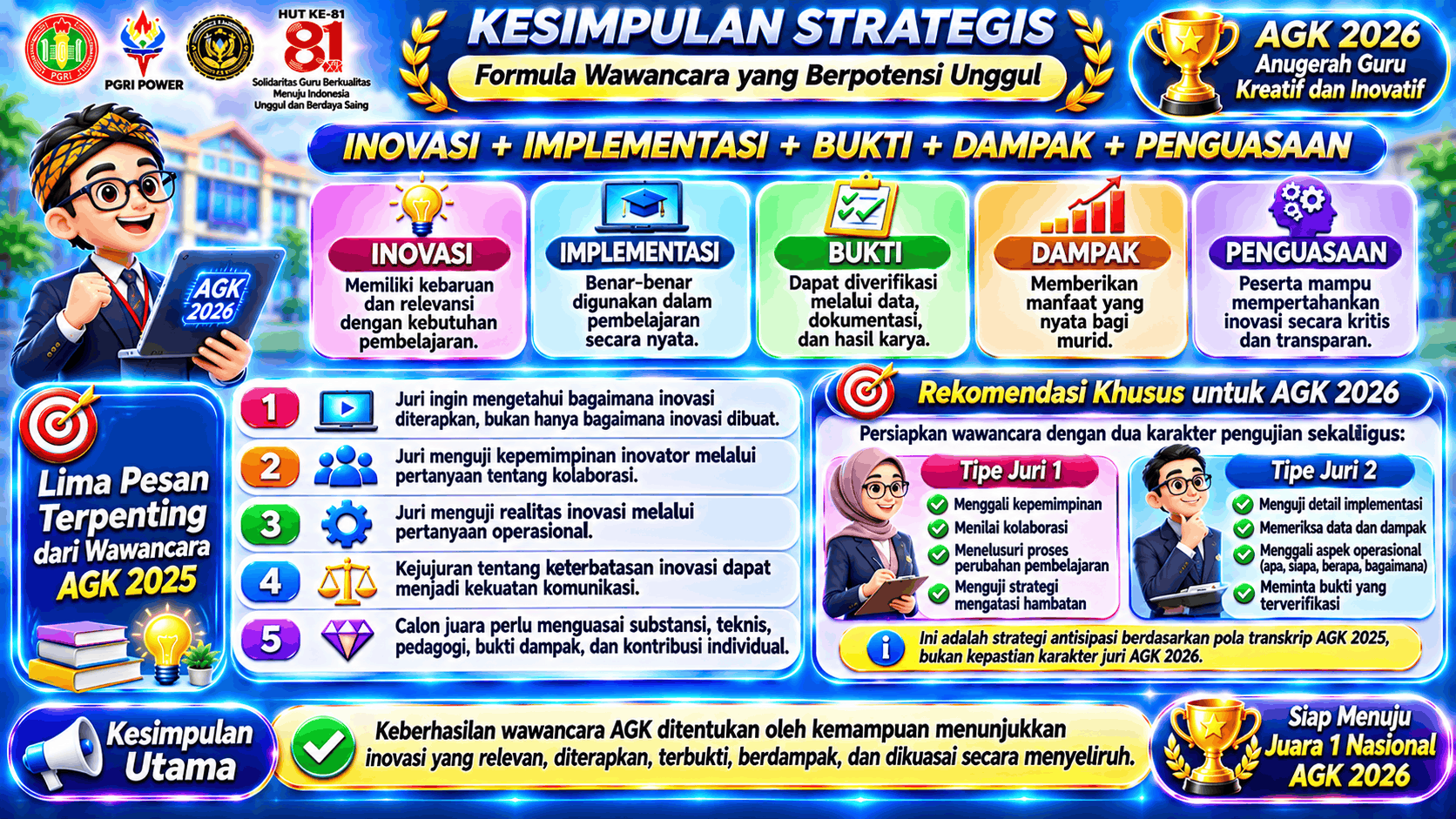
This analysis uses the SMAGALAPAK
educational innovation interview as a case study to understand how educational
innovations may be assessed in terms of leadership, collaboration,
implementation, impact, and mastery.
1. Reconstructing the Jury
Assessment Patterns
Based on the analysis of the AGK
2025 interview transcript, the assessment patterns can be reconstructed into
five strategic dimensions.
A. Innovation and Novelty
The jury seeks to understand the
problem behind the innovation, the solution developed, and its distinctive
features compared with existing practices. Participants need to demonstrate the
innovation’s relevance to actual educational needs.
B. Implementation and
Operations
An innovation should not merely
be presented as a product or prototype. The jury may explore how it is used,
who the users are, how it operates, and how extensively it has been implemented
in practice.
C. Leadership and
Collaboration
Leadership becomes essential when
an innovation involves teachers, students, parents, communities, or external
partners. Participants should explain how they build collaboration, overcome
barriers, and facilitate educational transformation.
D. Evidence and Impact
Claims of success must be
supported by verifiable evidence. The jury may investigate implementation
outcomes, observed changes, success indicators, and impact measurement methods.
E. Subject Mastery and
Individual Contribution
Participants must demonstrate
comprehensive understanding of their innovation, including technical,
pedagogical, ethical, security, and sustainability aspects. Their individual
contributions should be clearly distinguished from team responsibilities and supporting
technologies.
These five dimensions represent
an analytical reconstruction based on the interview transcript, not an official
AGK scoring rubric.
2. SMAGALAPAK Case Study:
Strengths and Lessons Learned
SMAGALAPAK is a school-based
educational e-commerce innovation developed through cross-subject collaboration
at SMA Negeri 3 Purwokerto. It connects learning with digital entrepreneurship
experiences through an ecosystem involving students, teachers, parents, and
local MSMEs.
Several strategic strengths
emerged from the AGK 2025 interview:
This experience demonstrates that
honesty about an innovation’s actual condition can strengthen communication.
Participants do not need to portray their innovations as having achieved
large-scale success. Instead, they should clearly explain progress, challenges,
and improvement plans.
3. Evaluating Evidence Gaps
One important lesson from the
interview analysis is the need to strengthen the connection between success
claims and supporting evidence.
Claims involving a 38–39%
increase in literacy or motivation and 87% teacher collaboration/adoption
require methodological details to ensure accountability, including:
Furthermore, individual
contributions, technical mastery, artificial intelligence utilization, and
evidence of deeper learning should be explained more systematically.
Strategic principle:
Simple but valid and transparent data are stronger than ambitious claims
without a clear verification method.
4. Strategies for AGK 2026
National Achievement
Preparation for AGK 2026 should
focus on strengthening five core elements:
Innovation + Implementation +
Evidence + Impact + Mastery
Recommended strategies include:
Participants should prepare for
two possible assessment approaches. The first focuses on leadership,
collaboration, and educational transformation. The second examines
implementation, data, operational details, and evidence.
These approaches are preparation
strategies based on AGK 2025 interview patterns, not definitive predictions of
the AGK 2026 jury’s characteristics.
5. A Strong Interview Response
Formula
To deliver structured responses,
participants can use the STAR + EVIDENCE method:
This method helps participants
provide concrete responses, avoid overly abstract explanations, and enable the
jury to conduct focused follow-up questioning.
Conclusion
The strategic analysis of the AGK
2025 interview indicates that competitive educational innovations must
demonstrate a clear relationship between ideas, implementation, collaboration,
evidence, and impact.
SMAGALAPAK illustrates how a
technology-based innovation can deliver educational value when it is applied in
authentic learning environments, supported by a collaborative ecosystem, and
developed sustainably.
Preparation for AGK 2026 should
prioritize substantive mastery, data validity, transparent individual
contributions, technical and pedagogical expertise, and reflective
communication.